
Project Sentinel
A real-time alarm monitoring prototype, built for a technical assessment for a security company: ingestion, computer vision, AI triage, and escalation, all designed to degrade safely instead of failing silently.
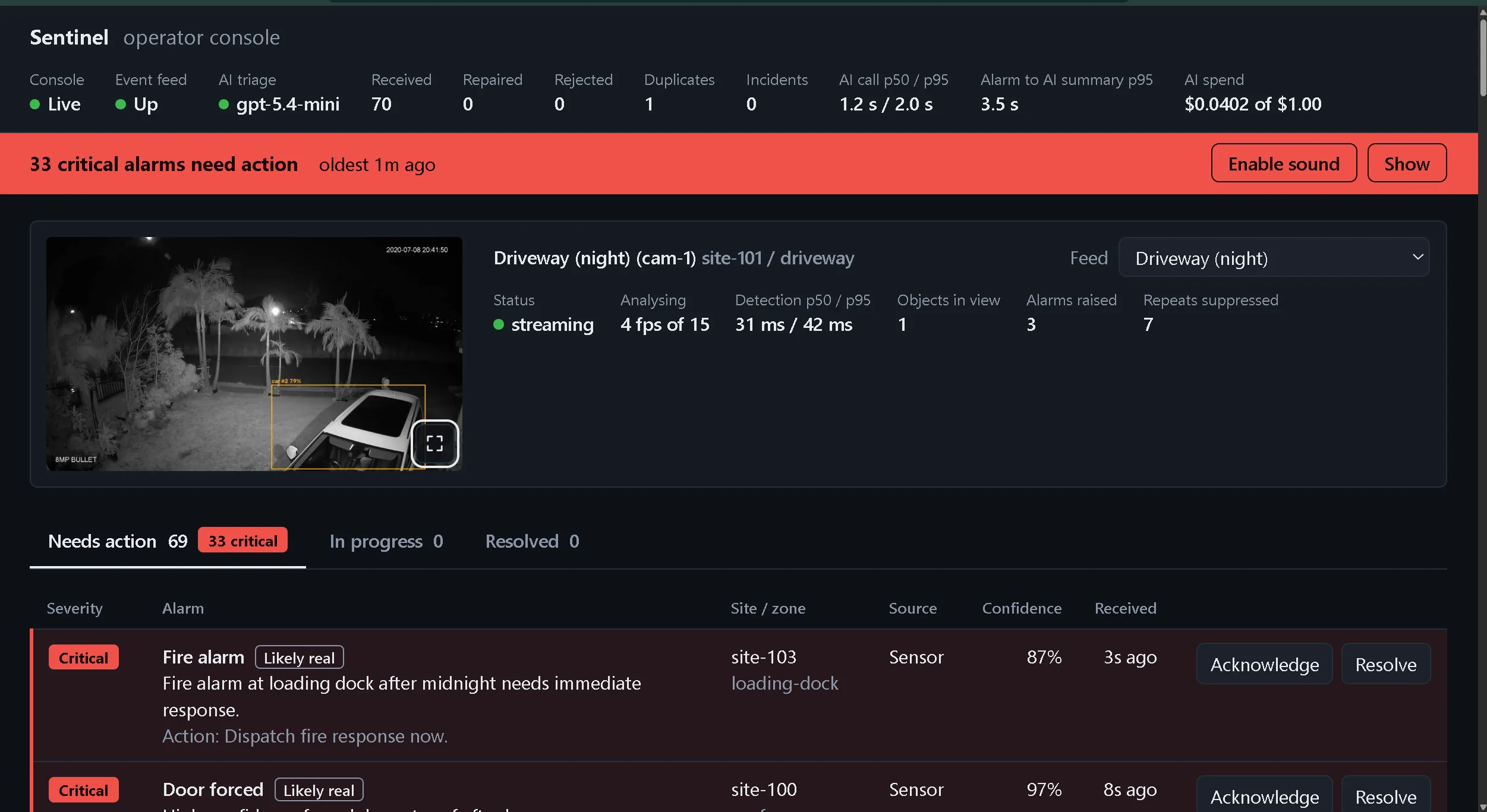
Security alarm systems that drown operators in false positives, or silently drop real threats when events arrive in bursts.
Security alarm platforms live or die on two things: never missing a real threat, and never burying operators under noise. Project Sentinel is a prototype that takes on both, end to end.
Events arrive over a WebSocket feed that bursts unpredictably. A camera worker runs object detection (YOLO26n on ONNX) on a separate process so video never blocks ingestion. Every event gets a rule-based severity first, then an AI triage pass classifies it as a real or false positive with a one-line action, backed by a hard spend cap and a rules-based fallback if the model is slow, down, or returns something unusable.
The store never loses an alarm: writes go through a write-behind SQLite layer with replay, verified by killing the backend mid-stream and confirming zero loss on restart. Under bursty load, the pipeline tracks received, accepted, rejected, and duplicate counts separately, so nothing silently disappears. Escalation rules were tuned against real volume: 18 pattern-based incidents raised out of 3,356 simulated alarms.